Visualizzazione post con etichetta quantum computers. Mostra tutti i post

lunedì 29 giugno 2009

Yale: the first rudimentary solid-state quantum processor of the history created

SOURCE

ScienceDaily (June 29, 2009) — A team led by Yale University researchers has created the first rudimentary solid-state quantum processor, taking another step toward the ultimate dream of building a quantum computer.
They also used the two-qubit superconducting chip to successfully run elementary algorithms, such as a simple search, demonstrating quantum information processing with a solid-state device for the first time. Their findings will appear in Nature's advanced online publication June 28.
"Our processor can perform only a few very simple quantum tasks, which have been demonstrated before with single nuclei, atoms and photons," said Robert Schoelkopf, the William A. Norton Professor of Applied Physics & Physics at Yale. "But this is the first time they've been possible in an all-electronic device that looks and feels much more like a regular microprocessor."
Working with a group of theoretical physicists led by Steven Girvin, the Eugene Higgins Professor of Physics & Applied Physics, the team manufactured two artificial atoms, or qubits ("quantum bits"). While each qubit is actually made up of a billion aluminum atoms, it acts like a single atom that can occupy two different energy states. These states are akin to the "1" and "0" or "on" and "off" states of regular bits employed by conventional computers. Because of the counterintuitive laws of quantum mechanics, however, scientists can effectively place qubits in a "superposition" of multiple states at the same time, allowing for greater information storage and processing power.
For example, imagine having four phone numbers, including one for a friend, but not knowing which number belonged to that friend. You would typically have to try two to three numbers before you dialed the right one. A quantum processor, on the other hand, can find the right number in only one try.
"Instead of having to place a phone call to one number, then another number, you use quantum mechanics to speed up the process," Schoelkopf said. "It's like being able to place one phone call that simultaneously tests all four numbers, but only goes through to the right one."
These sorts of computations, though simple, have not been possible using solid-state qubits until now in part because scientists could not get the qubits to last long enough. While the first qubits of a decade ago were able to maintain specific quantum states for about a nanosecond, Schoelkopf and his team are now able to maintain theirs for a microsecond—a thousand times longer, which is enough to run the simple algorithms. To perform their operations, the qubits communicate with one another using a "quantum bus"—photons that transmit information through wires connecting the qubits—previously developed by the Yale group.
The key that made the two-qubit processor possible was getting the qubits to switch "on" and "off" abruptly, so that they exchanged information quickly and only when the researchers wanted them to, said Leonardo DiCarlo, a postdoctoral associate in applied physics at Yale's School of Engineering & Applied Science and lead author of the paper.
Next, the team will work to increase the amount of time the qubits maintain their quantum states so they can run more complex algorithms. They will also work to connect more qubits to the quantum bus. The processing power increases exponentially with each qubit added, Schoelkopf said, so the potential for more advanced quantum computing is enormous. But he cautions it will still be some time before quantum computers are being used to solve complex problems.
"We're still far away from building a practical quantum computer, but this is a major step forward."
Authors of the paper include Leonardo DiCarlo, Jerry M. Chow, Lev S. Bishop, Blake Johnson, David Schuster, Luigi Frunzio, Steven Girvin and Robert Schoelkopf (all of Yale University), Jay M. Gambetta (University of Waterloo), Johannes Majer (Atominstitut der Österreichischen Universitäten) and Alexandre Blais (Université de Sherbrooke).
Citation: 10.1038/nature08121
Adapted from materials provided by Yale University.

sabato 27 giugno 2009

A scientist of Indian origin has created new ’superatoms’ with magnetic properties for the first time.


London, June 27 (ANI): A team of researchers led by a scientist of Indian origin has created new ’superatoms’ with magnetic properties for the first time, a breakthrough that could be used to make “spintronic devices”, faster computer processors and denser memory storage.
According to a report in New Scientist, the research was led by Shiv Khanna from Virginia Commonwealth University.
Superatoms were discovered in the 1980s when Walter Knight and colleagues at the University of California, Berkeley, found that groups of sodium atoms can share electrons amongst themselves.
The electrons form a collective “supershell” that coats the cluster.
Until now, clusters that copy the magnetic properties of other elements have proved more difficult to design.
Magnetism is caused by the spin of an atom’s electrons, which are arranged in shells, or orbitals, around the atom’s nucleus.
Their net spin determines the strength of the atom’s magnetic “moment,” and because they tend to occur in pairs that cancel each other out, it is the atom’s unpaired electrons that contribute to its magnetic moment.
Unpaired electrons, however, will make an atom, or a superatom, more likely to react with others in an attempt to fill its orbitals and become stable.
As a result, stability and magnetism have long been thought to be mutually exclusive.
A team led by Shiv Khanna at Virginia Commonwealth University has come up with a way around the problem.
Khanna’s team worked out that encapsulating an atom of vanadium in a cage of eight caesium atoms would create a stable supershell of electrons around the entire cluster.
This would prevent the vanadium atom’s unpaired electrons from reacting with other atoms, maintaining its magnetism.
The arrangement would yield a magnetic moment of five Bohr magnetons, which is the same as an atom of manganese.
“What we have done is expand the range of possible magnetic materials,” said Khanna.
Khanna’s magnetic superatoms are only calculations at this point, but he has funding from the Department of Energy to make them a reality.
He hopes the clusters can be used to give researchers a new dimension of control in designing new materials.
For example, stable magnetic clusters could one day be used in new “spintronic” devices, which compute or store information using magnetic moments rather than simply electrical charge.
Encoding data in this way means the devices can be far smaller than those used to make conventional electronic components, potentially providing an overall boost in computing power. (ANI)

A Higgs boson without the mess.

SOURCE

Particle physicists at CERN’s Large Hadron Collider (LHC) hope to discover the Higgs boson amid the froth of particles born from proton-proton collisions. Results in the 19 June Physical Review Letters show that there may be a way to cut through some of that froth. An experiment at Fermilab’s proton-antiproton collider in Illinois has identified a rare process that produces matter from the intense field of the strong nuclear force but leaves the proton and antiproton intact. There’s a chance the same basic interaction could give LHC physicists a cleaner look at the Higgs.
A proton is always surrounded by a swarm of ghostly virtual photons and gluons associated with the fields of the electromagnetic and strong nuclear forces. Researchers have predicted that when two protons (or a proton and an antiproton) fly past one another at close range, within about a proton’s diameter, these virtual particle clouds may occasionally interact to create new, real (not virtual) particles. The original protons would merely lose some momentum and separate from the beam. Such an “exclusive” reaction–where the original particles don’t break apart–gives unusually clean data because there are so few particles to detect.
In the new experiment, researchers were looking for signs that the interaction of virtual gluons had generated short-lived particles including the Χc (”Chi-c”) and J/ψ mesons, which are charm-anticharm quark pairs that decay into muons and antimuons. The Χc reaction would be especially rare because it requires protons to donate two gluons each, a requirement that also makes detailed predictions challenging, says Fermilab’s Mike Albrow, a member of the Collider Detector at Fermilab (CDF) collaboration.
In 2007, CDF researchers observed hints of exclusive, virtual gluon reactions in the form of high-energy photons radiating from colliding protons and antiprotons. Now the team has sifted through nearly 500 muon-antimuon pairs, identifying 65 that must have come from the decay of the Χc–very close to the rate predicted in 2005 by a team at Durham University in England. Because the Χc has similar particle properties to the much heavier Higgs boson, the same basic reaction should produce the Higgs at the higher collision energies provided by the LHC, says Albrow. “It’s the strongest evidence that the Higgs boson must be produced this way, if it does exist.”
Based on the rate of Χc production, Albrow estimates LHC collisions could produce 100 to 1000 Higgs bosons per year in each of the accelerator’s two largest particle detectors, ATLAS and CMS. “Even a few dozen events per year would enable you to measure the [Higgs's] mass, spin, and other properties,” he says. That’s why ATLAS and CMS teams are reviewing proposals to add detectors to look for exclusive Higgs events.
But not everyone is so optimistic that these events would be detectable in significant numbers. “It looks hard, but one should never say never,” says Joseph Incandela of the University of California, Santa Barbara, deputy physics coordinator for CMS. Incandela points out that once the LHC is operating at full capacity, every crossing of its twin proton beams is expected to yield about 20 collisions, throwing up other particles that may obscure exclusive reactions. But he says there are scenarios such as supersymmetry, a proposed extension to the standard model (the textbook theory of particle physics) in which there could be multiple Higgs bosons. In those situations, Albrow adds, exclusive reactions might be the only ones clean enough to distinguish the different Higgs particles.
by JR Minkel
JR Minkel is a freelance science writer in Nashville, Tennessee. His first book, Instant Egghead Guide: The Universe, comes out in July.
This story was first published in Physical Review Focus and is copyright American Physical Society. Reprinted with permission.
For more information on exclusive events, see the CERN Courier.

lunedì 22 giugno 2009

New method to detect quantum mechanical effects in ordinary objects

SOURCE

Scanning electron micrograph of a superconducting qubit in close proximity to a nanomechanical resonator. The nanoresonator is the bilayer (silicon nitride/aluminum) beam spanning the length of the trench in the center of the image; the qubit is the aluminum island located to the left of the nanoresonator. An aluminum electrode, located adjacent to the nanoresonator on the right, is used to actuate and sense the nanoresonator's motion. Credit: Electron beam lithography was performed by Richard Muller at JPL. Nanoresonator etch was performed by Junho Suh in the Roukes Lab. Image taken by Junho Suh.
At the quantum level, the atoms that make up matter and the photons that make up light behave in a number of seemingly bizarre ways. Particles can exist in "superposition," in more than one state at the same time (as long as we don't look), a situation that permitted Schrödinger's famed cat to be simultaneously alive and dead; matter can be "entangled" -- Albert Einstein called it "spooky action at a distance" -- such that one thing influences another thing, regardless of how far apart the two are.
Previously, scientists have successfully measured entanglement and in photons and in small collections of just a few atoms. But physicists have long wondered if larger collections of atoms--those that form objects with sizes closer to what we are familiar with in our day-to-day life--also exhibit quantum effects.
"Atoms and photons are intrinsically quantum mechanical, so it's no surprise if they behave in quantum mechanical ways. The question is, do these larger collections of atoms do this as well," says Matt LaHaye, a postdoctoral research scientist working in the laboratory of Michael L. Roukes, a professor of physics, applied physics, and bioengineering at the California Institute of Technology (Caltech) and codirector of Caltech's Kavli Institute.
"It'd be weird to think of ordinary matter behaving in a quantum way, but there's no reason it shouldn't," says Keith Schwab, an associate professor of applied physics at Caltech, and a collaborator of Roukes and LaHaye. "If single particles are quantum mechanical, then collections of particles should also be quantum mechanical. And if that's not the case--if the quantum mechanical behavior breaks down--that means there's some kind of new physics going on that we don't understand."
The tricky part, however is devising an experiment that can detect quantum mechanical behavior in such ordinary objects—without, for example, those effects being interfered with or even destroyed by the experiment itself.
Now, however, LaHaye, Schwab, Roukes, and their colleagues have developed a new tool that meets such fastidious demands and that can be used to search for quantum effects in a ordinary object. The researchers describe their work in the latest issue of the journal Nature.
In their experiment, the Caltech scientists used microfabrication techniques to create a very tiny nanoelectromechanical system (NEMS) resonator, a silicon-nitride beam—just 2 micrometers long, 0.2 micrometers wide, and weighing 40 billionths of a milligram—that can resonate, or flex back and forth, at a high frequency when a voltage is applied.
A small distance (300 nanometers, or 300 billionths of a meter) from the resonator, the scientists fabricated a second nanoscale device known as a single-Cooper-pair box, or superconducting "qubit"; a qubit is the basic unit of quantum information.
The superconducting qubit is essentially an island formed between two insulating barriers across which a set of paired electrons can travel. In the Caltech experiments, the qubit has only two quantized energy states: the ground state and an excited state. This energy state can be controlled by applying microwave radiation, which creates an electric field.
Because the NEMS resonator and the qubit are fabricated so closely together, their behavior is tightly linked; this allows the NEMS resonator to be used as a probe for the energy quantization of the qubit. "When the qubit is excited, the NEMS bridge vibrates at a higher frequency than it does when the qubit is in the ground state," LaHaye says.
One of the most exciting aspects of this work is that this same coupling should also enable measurements to observe the discrete energy levels of the vibrating resonator that are predicted by , the scientists say. This will require that the present experiment be turned around (so to speak), with the qubit used to probe the NEMS resonator. This could also make possible demonstrations of nanomechanical quantum superpositions and Einstein's spooky
"Quantum jumps are, perhaps, the archetypal signature of behavior governed by quantum effects," says Roukes. "To see these requires us to engineer a special kind of interaction between our measurement apparatus and the object being measured. Matt's results establish a practical and really intriguing way to make this happen."
More information: The paper, "Nanomechanical measurements of a superconducting qubit," was published in the June 18 issue of Nature.
Source: California Institute of Technology (news : web)

venerdì 12 giugno 2009

ATLAS (LHC,CERN) e-News: It’s like déjà-vu all over again

SOURCE

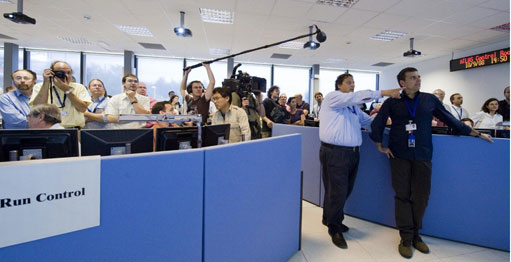
In the movie Groundhog Day, a reporter is forced to re-live a day (February 2) over and over again. Perhaps the coming LHC re-startup would feel like Groundhog Day to some science reporters. CERN therefore has no plans to invite the media here for the first beams this autumn. The first collisions at 450 on 450 GeV (hopefully a short time later) will also be kept low key. What is not fully decided is how to handle the first high-energy collisions and the first events from ATLAS and the other experiments.The images from last September (both control room scenes and the splash events) made a vivid impression on the news media and the public. This time ATLAS will not allow reporters within the Control Room, but the new Visitor Center allows a view of the activities, and new high-quality cameras (mounted on the back wall) can provide the video footage the media wants. The ATLAS website had more than two million hits during the September 2008 activities.Rumors are swirling that Tom Hanks may return to CERN to “turn on” the LHC, but of course that depends on the schedules of Hanks and the LHC. There are several stages in the startup process that could be defined as “turn-on”.Four members of the ATLAS outreach group have been travelling to Sony Pictures (near Hollywood) to help develop a 15-minute CERN/ATLAS “extra” that will be added to the DVD of Angels & Demons that will be released in November. We have also requested to get a copy of the five-minute segment near the beginning of the movie that has some spectacular cinematography of ATLAS. Have you seen our ATLAS webpages on antimatter at http://atlas.ch/angels-demons/ and the new exhibition in the Globe? Finally there have been at least 60 very successful lectures worldwide discussing the science of the movie and the science of LHC.In other news, design work is in progress to replace the aging posters in the Bldg. 40 café. The idea is to make the café an appealing place for physicists to chat and sip coffee, as well as to make it an interesting place to bring visitors to show them the basics of ATLAS.If you haven’t seen modern pop-up books, you will be surprised by the complexity they can portray. ATLAS will soon have its own dramatic pop-up book, a production led by Emma Sanders. It portrays both the detector and the physics.Work is in progress on an animation in the style of the ATLAS animations Episodes I and II. This new project is a joint effort with CMS to portray the physics of the LHC. Two professional animators are working on the project, and a senior person at Pixar has been consulting periodically. Completion date is approximately October 2009. Thought is also being given to an update of the 12-year-old ATLAS movie. All of our videos are on YouTube. Both CERN and ATLAS are working on new/updated communication plans. In the case of CERN, a draft plan has been circulated amongst the experiments. The ATLAS plan is in progress and should be completed in June.These are just the highlights of our activities. You can catch up on the whole series of outreach efforts at the next ATLAS overview week.
Michael Barnett
ATLAS Outreach

ATLAS (LHC,CERN) e-News: Category 1, on shift


SOURCE

To get any physics out of ATLAS, we must manage the data that will course through its cables, from the shifts in the control room to data distribution and software. Christophe Clement, Run Coordinator of ATLAS, describes this important work as less visible since it doesn’t directly result in papers. “And there’s a lot of it,” he adds. “Nevertheless, this is the work that really makes you feel you are carrying out an experiment which has to do with reality.”Control room tasks make up only about 13 per cent of the operation activities, according to Steinar Stapnes, who deals with Operation Task overall planning in ATLAS almost daily, yet they are essential. “Any failure in coverage can have bad consequences, perhaps for hardware and certainly for data taking,” he says.Each institute needs to take its turn on shift; this critical work cannot be compensated for with other contributions that are easier to accomplish remotely or require less diligent attention. For this reason, the Operation Task Planning group has split the operation tasks into two categories: 1 and 2.Category 1 tasks are the real-time operation and monitoring of detector performance, and first line of defence when problems arise, carried out by shifters in the control room and the experts who are called in at anytime of the day or night, should something go wrong. “We make sure that these very important tasks are well-covered. Everybody should feel responsible for them,” says Steinar.He also emphasizes the tradition in particle physics of making sure that graduate students and post-docs get time in the driver’s seat. “For most young people, it’s incredibly interesting, educational, and rewarding for them to get the experience of being part of the team that operates the detector,” says Steinar.Anything beyond the shifts will be Category 2. This includes data acquisition and core software development and maintenance, databases, calibrations, managing data distribution through the Grid, recalibration of data as the detectors are better understood, and software tuning. Category 2 also comprises other tasks associated with processing the data for analysis and those related to longer-term hardware and software maintenance at Point 1.Along with the special designation for shifts and on-call time, the scheduling system has changed. Run Coordination wants to foster a team spirit among the shifters, bringing groups together multiple times over the course of a week. Christophe explained that in this team-based system, shifters: “Get to know the other crew members better, make new contacts, and become more confident with the operation of their sub-detector. Basically work more as a crew.” “It’s not something new in some sense; other experiments have done similar things,” says Steinar, “but it is different with ATLAS because of a larger crew and a large collaboration.”Since collaborators may only work shifts for a maximum of six consecutive days, Run Coordination tried to make a schedule with eight-day blocks, each shifter taking one day off during the block. However, this was in the end deemed too rigid, both for people travelling to CERN to do shifts and for CERN residents. This resulted in a spontaneously generated version with three- and four-day blocks. An unintended consequence was that visiting physicists were inclined to take two blocks in succession, resulting in seven consecutive shifts. CERN safety regulations must be respected, so Run Coordination adjusted the system to allow shifters to choose two consecutive three-day shifts.

This system is also designed to respect the experts who are on-call. In the pattern above, those who work over the weekend have at least a Friday’s worth of experience. This way, the teams are more likely to be able to handle problems without calling in an expert. Christophe notes that on the first day, shifters tend to do some re-learning, but during the rest of a block: “you’ve done this yesterday, and you know what is the problem and how to fix it.”Also, those who take night shift must have recent experience on a day or evening shift, to avoid exhausting the on-call experts with midnight questions and visits to the Control Room. Between the category definitions and block scheduling for shifts, the running of the ATLAS detector should be smooth and effective, with each institution carrying its weight on the front lines.The system starts up Week 26 (28 June to 4 July). For more information or to book a shift, check the webpage.

Katie McAlpine
ATLAS e-News

ATLAS (LHC,CERN) e-News: Cosmic shakedown


For the last seven weeks, ATLAS has been going through the motions, practicing and problem-solving in preparation for beam.Like a choir rehearsing ahead of a concert, the first five weeks – so called ‘slice weeks’ – each focused on running different combinations of parts of the detector, to inspect how each performed and cooperated.Week 1, commencing April 13th, was all about the SCT, Pixels, and Beam Condition Monitor.
Week 2 dealt with the Tile and Liquid Argon calorimeters, the L1 Calo trigger system, and some High Level Trigger (HLT) algorithms specific to the calorimeters. The third week concentrated on the suite of muon sub-systems.Week 4 took things up a notch, combining all of the above and focusing on testing HLT algorithms as much as possible with cosmics. Finally, week 5 was the first time that the forward detectors – LUCID and the Zero Degree Calorimeter – had been run together and integrated into the ATLAS data stream. Look out for articles reporting in more detail on these final two weeks in the next issue of e-News (June 15th).Due to ongoing work on the cooling for the silicon detectors, the SCT and Pixel detectors could not be switched on, and so week 1 involved only the off-detector part of Pixel and SCT electronics, with Monte Carlo data being 'plugged' into their readout devices. The rest of the slice weeks were full cosmic runs.The muon detectors with the largest surface areas can detect 1000 cosmic particles per second, but in LHC conditions, up to 100,000 ‘interesting’ events will be sent to the HLT per second. To simulate the stress on the HLT, ‘fake’ so-called random triggers were layered on top of the cosmic ones.“We’ve tested so far up to 80 kilohertz. The bulk of this is fake triggers, with about 1 kilohertz of real cosmic muons,” says Run Coordinator Christophe Clement. “The HLT can filter out the fake triggers, run algorithms on the real cosmic ones, and then write maybe 200 interesting ones per second to Tier 0.”According to Christophe, the slice weeks have been pretty successful, particularly considering how much the landscape has changed since the detectors were last run together, in Autumn 2008; the Detector Control System (DCS) which monitors the hardware has been upgraded, bits of the detectors have been replaced and repaired, the online software and HLT software have both been upgraded, and the whole detector has been opened and is now almost closed.“I think we can say now that we have upgraded all software for Data Acquisition and Trigger as well as the Detector Control System, and we’re more or less at the same level that we were last year in terms of stability,” says Christophe “and then we start to push more at the trigger rates.”Stability tests, where the system is left to run unhampered for extended periods, were performed on the weekends of the slice weeks. “It’s like a test-program for a plane,” explains Christophe, “they’re going to do all possible things: fly it into a storm, try to land it when it’s snowing. That’s what we do during the week. Then on the Friday evening, we say ‘OK, now we’ll just try to fly straight for the weekend, without touching anything, and see if it works for a long flight’.”Most of the sub-systems were able to run well for extended periods, although there were some unexpected instabilities at high rate. This week and next, experts from the calorimeters and L1 Calo will meet in Geneva to try to get to the bottom of those problems.Weekend tests were also run using a simulated beam schedule, to give groups a better sense of how they will need to work during beam time – stopping and starting and reconfiguring between LHC fills. “We were quite positively surprised at how well we were able to do this,” says Christophe, reporting crude data-taking efficiency calculations of 91 per cent during the long muon weekend. Ignoring a glitch on the general power grid on a certain Sunday morning at 3 a.m., the figure for the calorimeter weekend would have been 97 per cent.Since the slice weeks, more tests have been done with the muon system and the TRT, as ATLAS works towards a two-week combined magnet run, due to begin on June 22nd.“For these two weeks, we hope to run cosmics with less debugging,” says Christophe. “The weeks we had so far were really to try to address technical issues. Hopefully [the combined run] will be much smoother, and we can calculate our data taking efficiency much better.”The data taken so far will be analysed for weeks to come, and used to perfect the calibration, alignment, and synchronisation of ATLAS. Over 40 million cosmic events were triggered in the muon slice week alone, and there is now a big push to bring trigger timings for different parts of the detector and different types of triggers into alignment. When real collision particles start shooting through the different layers of the detector, all the electronics must be synchronised and shouting their findings in unison, a choir hitting its notes in time. “We’re fine-tuning this now,” says Christophe. “If we can get everything within 25 to 50 nanoseconds on the cosmics before the beam it would be a great success. And then we can improve with the collisions.”
Ceri Perkins
ATLAS e-News

martedì 9 giugno 2009

Many Worlds Interpretation (Hugh Everett's Theory) MWI: Testability and Objections

Testability:
Despite the name "interpretation", the MWI is a variant of quantum theory that is different from others. Experimentally, the difference is relative to collapse theories. It seems that there is no experiment distinguishing the MWI from other no-collapse theories such as Bohmian mechanics or other variants of MWI.
The collapse leads to effects that are, in principle, observable; these effects do not exist if the MWI is the correct theory. To observe the collapse we would need a super technology, which allows "undoing" a quantum experiment, including a reversal of the detection process by macroscopic devices. See Lockwood 1989 (p. 223), Vaidman 1998 (p. 257), and other proposals in Deutsch 1986. These proposals are all for gedanken experiments that cannot be performed with current or any foreseen future technology. Indeed, in these experiments an interference of different worlds has to be observed. Worlds are different when at least one macroscopic object is in macroscopically distinguishable states. Thus, what is needed is an interference experiment with a macroscopic body. Today there are interference experiments with larger and larger objects (e.g., fullerene molecules C60), but these objects are still not large enough to be considered "macroscopic". Such experiments can only refine the constraints on the boundary where the collapse might take place. A decisive experiment should involve the interference of states which differ in a macroscopic number of degrees of freedom: an impossible task for today's technology.[8]
The collapse mechanism seems to be in contradiction with basic physical principles such as relativistic covariance, but nevertheless, some ingenious concrete proposals have been made (see Pearle 1986 and the entry on collapse theories). These proposals (and Weissman's 1999 non-linear MW idea) have additional observable effects, such as a tiny energy non-conservation, that were tested in several experiments. The effects were not found and some (but not all!) of these models have been ruled out.
In most no-collapse interpretations, the evolution of the quantum state of the Universe is the same. Still, one might imagine that there is an experiment distinguishing the MWI from another no-collapse interepretation based on the difference in the correspondence between the formalism and the experience (the results of experiments).
An apparent candidate for such an experiment is a setup proposed in Englert et al. 1992 in which a Bohmian world is different from the worlds of the MWI (see also Aharonov and Vaidman 1996). In this example, the Bohmian trajectory of a particle in the past is contrary to the records of seemingly good measuring devices (such trajectories were named surrealistic). However, at present, there are no memory records that can determine unambiguously (without deduction from a particular theory) the particle trajectory in the past. Thus, this difference does not lead to an experimental way of distinguishing between the MWI and Bohmian mechanics. I believe that no other experiment can distinguish between the MWI and other no-collapse theories either, except for some perhaps exotic modifications, e.g., Bohmian mechanics with initial particle position distribution deviating from the quantum distribution. There are other opinions about the possibility of testing the MWI. It has frequently been claimed, e.g. by De Witt 1970, that the MWI is in principle indistinguishable from the ideal collapse theory. On the other hand, Plaga 1997 claims to have a realistic proposal for testing the MWI, and Page 2000 argues that certain cosmological observations might support the MWI.
Objections to the MWI:
Some of the objections to the MWI follow from misinterpretations due to the multitude of various MWIs. The terminology of the MWI can be confusing: "world" is "universe" in Deutsch 1996, while "universe" is "multiverse", etc. There are two very different approaches with the same name "The Many-Minds Interpretation (MMI)". The Albert and Loewer 1988 MMI mentioned above should not be confused with
Lockwood’ 1996 MMI (which resembles the approach of Zeh 1981). The latter is much closer to the MWI as it is presented here, see Sec. 17 of Vaidman 1998. Further, the MWI in the Heisenberg representation (Deutsch 2001) differs significantly from the MWI presented in the Schrödinger representation (used here). The MWI presented here is very close to Everett's original proposal, but in the entry on Everett's relative state formulation of quantum mechanics, as well as in his book Barrett 1999, Barrett uses the name "MWI" for the splitting worlds view publicized by De Witt 1970. This approach has been justly criticized: it has both some kind of collapse (an irreversible splitting of worlds in a preferred basis) and the multitude of worlds. Now I consider the main objections in detail.
Ockham's Razor:
It seems that the majority of the opponents of the MWI reject it because, for them, introducing a very large number of worlds that we do not see is an extreme violation of Ockham's principle: "Entities are not to be multiplied beyond necessity". However, in judging physical theories one could reasonably argue that one should not multiply physical laws beyond necessity either (such a verion of Ockham's Razor has been applied in the past), and in this respect the MWI is the most economical theory. Indeed, it has all the laws of the standard quantum theory, but without the collapse postulate, the most problematic of physical laws. The MWI is also more economic than Bohmian mechanics which has in addition the ontology of the particle trajectories and the laws which give their evolution. Tipler 1986 (p. 208) has presented an effective analogy with the criticism of Copernican theory on the grounds of Ockham's razor.
One might consider also a possible philosophical advantage of the plurality of worlds in the MWI, similar to that claimed by realists about possible worlds, such as Lewis 1986 (see the discussion of the analogy between the MWI and Lewis's theory by Skyrms 1976). However, the analogy is not complete: Lewis' theory considers all logically possible worlds, many more than all worlds incorporated in the quantum state of the Universe.

sabato 16 maggio 2009

Super-efficient Transistor Material Predicted


(PhysOrg.com) -- New work by condensed-matter theorists at the Stanford Institute for Materials and Energy Science at SLAC National Accelerator Laboratory points to a material that could one day be used to make faster, more efficient computer processors.
In a paper published online Sunday in , SIMES researchers Xiao-Liang Qi and Shou-Cheng Zhang, with colleagues from the Chinese Academy of Sciences and Tsinghua University in Beijing, predict that a room temperature material will exhibit the quantum spin Hall effect. In this exotic state of matter, flow without dissipating heat, meaning a transistor made of the material would be drastically more efficient than anything available today. This effect was previously thought to occur only at extremely low temperatures. Now the race is on to confirm the room-temperature prediction experimentally.
Zhang has been one of the leading physicists working on the quantum spin Hall effect; in 2006 he predicted its existence in mercury telluride, which experimentalists confirmed a year later. However, the mercury telluride had to be cooled by liquid helium to a frigid 30 millikelvins, much too cold for real-world applications.
In their hunt for a material that exhibited the quantum spin Hall effect, Zhang and Qi knew they were looking for a solid with a highly unusual energy landscape. In a normal semiconductor, the outermost electrons of an atom prefer to stay in the valence band, where they are orbiting atoms, rather than the higher-energy conduction band, where they move freely through the material. Think of the conduction band as a flat plain pitted with small valence-band valleys. Electrons naturally "roll" down into these valleys and stay there, unless pushed out. But in a material that exhibits the quantum spin Hall effect, this picture inverts; the valence-band valleys rise to become hills, and the electrons roll down to roam the now lower-energy conduction band plain. In mercury telluride, this inversion did occur, but just barely; the hills were so slight that a tiny amount of energy was enough to push the electrons back up, meaning the material had to be kept extremely cold.
When Zhang, Qi and their colleagues calculated this energy landscape for four promising materials, three showed the hoped-for inversion. In one, bismuth selenide, the theoretical conduction band plain is so much lower than the valence band hills that even room temperature energy can't push the electrons back up. In physics terms, the conduction band and valence band are now inverted, with a sizeable difference between them.
"The difference [from mercury telluride] is that the gap is much larger, so we believe the effect could happen at room temperature," Zhang explained.
Materials that exhibit the quantum spin Hall effect are called topological insulators; a chunk of this material acts like an empty metal box that's completely insulating on the inside, but conducting on the surface. Additionally, the direction of each electron's movement on the surface decides its spin, an intrinsic property of electrons. This leads to surprising consequences.
Qi likens electrons traveling through a metal to cars driving along a busy road. When an electron encounters an impurity, it acts like a frustrated driver in a traffic jam, and makes a U-turn, dissipating heat. But in a topological insulator, Qi said, "Nature gives us a no U-turn rule." Instead of reversing their trajectories, electrons cruise coolly around impurities. This means the quantum spin Hall effect, like superconductivity, enables current to flow without dissipating energy, but unlike superconductivity, the effect doesn't rely on interactions between electrons.
Qi points out that, because current only flows on their surfaces, topological insulators shouldn't be seen as a way to make more efficient power lines. Instead, these novel compounds would be ideal for fabricating tinier and tinier transistors that transport information via electron spin.
"Usually you need magnets to inject spins, manipulate them, and read them out," Qi said. "Because the current and spin are always locked [in a topological insulator], you can control the spin by the current. This may lead to a new way of designing devices like transistors."
These tantalizing characteristics arise from underlying physics that seems to marry relativity and condensed matter science. Zhang and Qi's paper reveals that electrons on the surface of a topological insulator are governed by a so-called "Dirac cone," meaning that their momentum and energy are related according to the laws of relativity rather than the quantum mechanical rules that are usually used to describe electrons in a solid.
"On this surface, the electrons behave like a relativistic, massless particle," Qi said. "We are living in a low speed world here, where nothing is relativistic, but on this boundary, relativity emerges."
"What are the two greatest physics discoveries of the last century? Relativity and quantum mechanics." Zhang said. "In the semiconductor industry in the last 50 years, we've only used quantum mechanics, but to solve all these interesting frontier problems, we need to use both in a very essential way."
Zhang and Qi's new predictions are already spurring a surge of experiments to test whether these promising materials will indeed act as room-temperature topological insulators.
"The best feedback you can get is that there are lots of experiments going on," he said.
More information: http://www.nature.com/nphys/journal/vaop/ncurrent/abs/nphys1270.html
Provided by SLAC National Accelerator Laboratory (news : web)

giovedì 14 maggio 2009

Researchers develop new method for producing transparent conductors

(PhysOrg.com) -- Researchers at UCLA have developed a new method for producing a hybrid graphene-carbon nanotube, or G-CNT, for potential use as a transparent conductor in solar cells and consumer electronic devices. These G-CNTs could provide a cheaper and much more flexible alternative to materials currently used in these and similar applications.
Yang Yang, a professor of materials science and engineering at the UCLA Henry Samueli School of Engineering and Applied Science and a member of UCLA's California NanoSystems Institute (CNSI), and Richard Kaner, a UCLA professor of chemistry and biochemistry and a CNSI member, outline their new processing method in research published today in , a .
Transparent conductors are an integral part of many electronic devices, including flat-panel televisions, plasma displays and touch panels, as well as . The current gold standard for transparent conductors is (ITO), which has several limitations. ITO is expensive, both because of its production costs and a relative scarcity of indium, and it is rigid and fragile.
The G-CNT hybrid, the researchers say, provides an ideal high-performance alternative to ITO in electronics with moving parts. is an excellent electrical conductor, and carbon nanotubes are good candidates for transparent conductors because they provide conduction of electricity using very little material. Yang and Kaner's new single-step method for combining the two is easy, inexpensive, scalable and compatible with flexible applications. G-CNTs produced this way already provide comparable performance to current ITOs used in flexible applications.
The new method builds on Yang and Kaner's previous research, published online in November 2009, which introduced a method for producing graphene, a single layer of , by soaking graphite oxide in a hydrazine solution. The researchers have now found that placing both graphite oxide and carbon nanotubes in a hydrazine solution produces not only graphene but a hybrid layer of graphene and carbon nanotubes.
"To our knowledge this is the first report of dispersing CNTs in anhydrous hydrazine," Yang said. "This is important because our method does not require the use of surfactants, which have traditionally been used in these solution processes and can degrade intrinsic electronic and mechanical properties."
G-CNTs are also ideal candidates for use as electrodes in polymer solar cells, one of Yang's main research projects. One of the benefits of polymer, or plastic, solar cells is that plastic is flexible. But until an alternative to ITOs, which lose efficiency upon flexing, can be found, this potential cannot be exploited. G-CNTs retain efficiency when flexed and also are compatible with plastics. Flexible solar cells could be used in a variety of materials, including the drapes of homes.
"The potential of this material (G-CNT) is not limited to improvements in the physical arrangements of the components," said Vincent Tung, a doctoral student working jointly in Yang's and Kaner's labs and the first author of the study. "With further work, G-CNTs have the potential to provide the building blocks of tomorrow's optical electronics."
Source: University of California - Los Angeles

mercoledì 13 maggio 2009

New element found to be a superconductor

(PhysOrg.com) -- Of the 92 naturally occurring elements, add another to the list of those that are superconductors. James S. Schilling, Ph.D., professor of physics in Arts & Sciences at Washington University in St. Louis, and Mathew Debessai — his doctoral student at the time — discovered that europium becomes superconducting at 1.8 K (-456 °F) and 80 GPa (790,000 atmospheres) of pressure, making it the 53rd known elemental superconductor and the 23rd at high pressure.
Debessai, who receives his doctorate in physics at Washington University's Commencement May 15, 2009, is now a postdoctoral research associate at Washington State University.
"It has been seven years since someone discovered a new elemental superconductor," Schilling said. "It gets harder and harder because there are fewer elements left in the periodic table."
This discovery adds data to help improve scientists' theoretical understanding of superconductivity, which could lead to the design of room-temperature superconductors that could be used for efficient energy transport and storage.
The results are published in the May 15, 2009, issue of Physical Review Letters in an article titled "Pressure-induced Superconducting State of Europium Metal at Low Temperatures."
Schilling's research is supported by a four-year $500,000 grant from the National Science Foundation, Division of Materials Research.
Europium belongs to a group of elements called the rare earth elements. These elements are magnetic; therefore, they are not superconductors.
"Superconductivity and magnetism hate each other. To get superconductivity, you have to kill the magnetism," Schilling explained.
Of the rare earths, europium is most likely to lose its magnetism under high pressures due to its electronic structure. In an elemental solid almost all rare earths are trivalent, which means that each atom releases three electrons to conduct electricity.
"However, when europium atoms condense to form a solid, only two electrons per atom are released and europium remains magnetic. Applying sufficient pressure squeezes a third electron out and europium metal becomes trivalent. Trivalent europium is nonmagnetic, thus opening the possibility for it to become superconducting under the right conditions," Schilling said.
Schilling uses a diamond anvil cell to generate such high pressures on a sample. A circular metal gasket separates two opposing 0.17-carat diamond anvils with faces (culets) 0.18 mm in diameter. The sample is placed in a small hole in the gasket, flanked by the faces of the diamond anvils.
Pressure is applied to the sample space by inflating a doughnut-like bellow with helium gas. Much like a woman in stilettos exerts more pressure on the ground than an elephant does because the woman's force is spread over a smaller area, a small amount of helium gas pressure (60 atmospheres) creates a large force (1.5 tons) on the tiny sample space, thus generating extremely high pressures on the sample.
Unique electrical, magnetic properties
Superconducting materials have unique electrical and magnetic properties. They have no electrical resistance, so current will flow through them forever, and they are diamagnetic, meaning that a magnet held above them will levitate.
These properties can be exploited to create powerful magnets for medical imaging, make power lines that transport electricity efficiently or make efficient power generators.
However, there are no known materials that are superconductors at room temperature and pressure. All known superconducting materials have to be cooled to extreme temperatures and/or compressed at high pressure.
"At ambient pressure, the highest temperature at which a material becomes superconducting is 134 K (-218 °F). This material is complex because it is a mixture of five different elements. We do not understand why it is such a good superconductor," Schilling said.
Scientists do not have enough theoretical understanding to be able to design a combination of elements that will be at room temperature and pressure. Schilling's result provides more data to help refine current theoretical models of superconductivity.
"Theoretically, the elemental solids are relatively easy to understand because they only contain one kind of atom," Schilling said. "By applying pressure, however, we can bring the elemental solids into new regimes, where theory has difficulty understanding things.
"When we understand the element's behavior in these new regimes, we might be able to duplicate it by combining the into different compounds that superconduct at higher temperatures."
Schilling will present his findings at the 22nd biennial International Conference on High Science and Technology in July 2009 in Tokyo, Japan.
Provided by Washington University in St. Louis (news : web)

Ion trap quantum computing


(PhysOrg.com) -- “Right now, classical computers are faster than quantum computers,” René Stock tells PhysOrg.com. “The goal of quantum computing is to eventually speed up the time scale of solving certain important problems, such as factoring and data search, so that quantum computing can not only compete with, but far outperform, classical computing on large scale problems. One of the most promising ways to possibly do this is with ion traps.”
Stock, a post-doc at the University of Toronto, points out that ion trap has made a lot of progress in the last 10 years. “ in traps have been one of most successful physical implementation of quantum computing in physical systems.” Stock believes that it is possible to use ion-trap quantum computing to create measurement-based quantum computers that could compete with classical computers for very large and complex problems - and even on smaller scale problems. His work on the subject, done with Daniel James, appears in Physical Review Letters: “Scalable, High-Speed Measurement-Based Quantum Computer Using Trapped Ions.”
“One of the most important considerations in quantum computing is the fact that quantum computing scales polynomially, rather than exponentially, as classical computing does.” This polynomial scaling is what makes quantum computing so useful for breaking data encryption. In order to make data encryption more secure, one usually increases the number of bits used. “Because of the exponential scaling, breaking data encryptions quickly becomes impossible using standard classical computers or even networks of computers,” Stock explains. “The improved scaling with quantum computers could be one a biggest threads to data encryption and security.”
While this sounds promising, Stock points this out that there are still problems with quantum information processing: “While scaling would be better with quantum computing, current operation of quantum information processing is too slow to even compete with classical computers on large factoring problems that take 5 months to solve.”
The way ion-trap quantum computing works now - or at least is envisioned to work - requires that ions be shuttled back and forth around the trap architecture. Stock explains that this takes time. “As the complexity of problems and the size of the quantum computing to be implemented increases, the time issue becomes even more important. We wanted to figure out how we could change the time scale,” Stock explains. “We found that we could speed up the processing by using an array of trapped ions and by parallelizing entangling operations.”
“Instead of moving ions around,” Stock continues, “you apply a two-ion operation between all neighboring ions at the same time. The created multipartite ‘entangled’ array of ions is a resource for quantum computing.” Actual computing is then based on measurement of ions in the array in a prescribed order and using a slightly different measurement basis for each ion. “In this scheme, it is the time required to read out information from the ions that critically determines the operational time scale of the quantum computer,” Stock says.
Stock describes the measurement component as vital to this model of quantum computing. Instead of exciting the ions and getting them to emit a photon and measuring the photon, Stock and his colleague instead devised a different way in which they were able to measure the quantum bit encoded in a calcium ion. “You can use an ionization process to speed up measurement, since the electron can be extracted faster from the atom than you can get a photon out of an atom. The extracted electron is then guided onto a detector by the ion trap itself.” All of this takes place on a nanosecond time scale. “By speeding up the measurement,” Stock insists, “we can speed up the operation capability of the quantum computer.”
Stock points out that this scheme would be impractical as far as taking over common use from classical computers. “The lattice would have thousands of ions, which would need to be controlled, and carefully stored and protected. It means that the computer would be relatively large and impractical.”
Uses for such a quantum computer are not limited to breaking data encryption. “This process would allow us to take problems of great complexity and still solve them on a humanly possible timescale. This could provide the key to modeling complex systems - especially perhaps in biology - that we can’t solve now. This would be a tremendous advantage over classical computing.”
More information: Stock, René and James, Daniel. “Scalable, High-Speed Measurement-Based Quantum Computer Using Trapped Ions.” Physical Review Letters (2009). Available online: http://link.aps.org/doi/10.1103/PhysRevLett.102.170501 .
Copyright 2009 PhysOrg.com. All rights reserved. This material may not be published, broadcast, rewritten or redistributed in whole or part without the express written permission of PhysOrg.com.

martedì 12 maggio 2009

Too much entanglement can destroy the power of quantum computers!


Computers that exploit quantum effects appear capable of outperforming their classical brethren. For example, a quantum computer can efficiently factor a whole number, while there is no known algorithm for our modern classical computers to efficiently perform this task [1]. Given this extra computational punch, a natural question to ask is “What gives quantum computers their added computational power?” This question is intrinsically hard—try asking yourself where the power of a traditional classical computer comes from and you will find yourself pondering questions at the heart of the vast and challenging field known as computational complexity. In spite of this, considerable success has been made in answering the question of when a quantum system is not capable of offering a computational speedup. A particularly compelling story has emerged from the study of entanglement—a peculiar quantum mechanical quality describing the interdependence of measurements made between parts of a quantum system. This work has shown that a quantum system without enough entanglement existing at some point in the process of a computation cannot be used to build a quantum computer that outperforms a classical computer [2]. Since entangled quantum systems cannot be replicated by local classical theories, the idea that entanglement is required for speedup seems very natural. But now two groups [3, 4] have published papers in Physical Review Letters that put forth a surprising result: sometimes too much entanglement can destroy the power of quantum computers!
Both papers focus on a model called the “one-way quantum computer,” which was invented by Hans Briegel and Robert Raussendorf in 2001 [5]. A one-way quantum computation begins with a special quantum state entangled across many quantum subsystems, and the computation proceeds as a measurement is made on each subsystem. The actual form of each of the measurements in the sequence of measurements is determined by the outcome of previous measurements (Fig. 1), and one can think of the measurements as an adaptive program executed on the substrate of the entangled quantum state. A particularly nice property of the one-way quantum computing model is that it separates quantum computing into two processes—the preparation of a special initial quantum state and a series of adaptive measurements. In this way we may view the initial quantum state as a resource that can boost localized measurements and classical computation up into quantum realms. Investigations have revealed numerous quantum states that can be used as the special initial state to build a fully functioning quantum computer. But how special is this initial quantum state? Will any entangled quantum state do?
The two papers approach this problem from slightly different perspectives, but both arrive at convincing answers to these questions. David Gross at Technische Universität Braunschweig in Germany, Steven Flammia at the Perimeter Institute for Theoretical Physics in Waterloo, Canada, and Jen Eisert at the University of Potsdam, Germany, pursue this question directly in terms of entanglement [3]. They first show that if a certain quantification of entanglement—known as the geometric measure of entanglement—is too large, then any scheme that mimics the one-way quantum computation model cannot outperform classical computers. In fact, they show that the measurements in this case could be replaced by randomly flipping a coin, without significantly changing the effect of the computation. Thus while these states have a large amount of entanglement, they cannot be used to build a one-way quantum computer. Gross, Flammia, and Eisert also show that if one picks a random quantum state, it will, with near certainty, be a state that has a high value of geometric entanglement. The random states they consider are drawn via a probability distribution known as the Haar measure, which is the probability distribution that arises naturally when one insists that the probability of drawing a particular state not depend in any way on the basis of states one uses to describe a quantum system. Gross et al.’s findings show that not only do states that are too entangled to allow one-way quantum computation exist, they are actually generic among all quantum states.
Michael J. Bremner and Andreas Winter of the University of Bristol in the UK and Caterina Mora at the University of Waterloo in Canada take a slightly different route to finding states that are not useful for one-way quantum computation [4]. They begin by showing that a random quantum state (again drawn from the Haar measure) is not useful for one-way quantum computation with high probability, confirming the result of Gross et al. But they also show it is possible to choose a random quantum state from an even smaller class of states than the completely random quantum states and still end up with a state not useful for one-way quantum computation. This more limited class of states has even less entanglement (though still quite a lot) than those considered by Gross et al., but they can still be useless for one-way quantum computation.
The bottom line is that entanglement, like most good things in life, must be consumed in moderation. For the one-way quantum computation model, a randomly chosen initial state followed by adaptive measurements is not going to give you a quantum computer. Part of the reason for this, as revealed by Gross et al., is that a randomly chosen initial state has too much geometric entanglement. But even states with less entanglement may be useless for one-way quantum computation. All is according to the color of the crystal through which you look, however, one may naturally ask: What do all of these statements about the power of initial random quantum states have to do with the real world? It is thought, for example, that perfectly random quantum states (drawn from the Haar measure) cannot be produced efficiently on a quantum computer. So, while it may be that a perfectly random quantum state isn’t useful for one-way quantum computation, maybe the states that exist in nature, which can be constructed efficiently, actually are useful. It is known, for example, that the ground states of certain chains of interacting spins can be used for one-way quantum computation. A recent preprint by Richard Low [6] hints, however, that even states that exist in nature might also be in the class of useless states considered by Gross et al. and Bremner et al. In particular, Low has shown that there is a way to efficiently construct a class of entangled random quantum states that are not useful for one-way quantum computation. Thus the kinds of generic situations that both groups consider should not be ruled out because there is no physical model that efficiently prepares these states: quantum states that are impotent for one-way quantum computation may be the norm and not the exception. The implications for this on the viability of one-way quantum computation are probably not dire, but it does point out how special the states that can be useful for this model need to be—as well as the clever thinking needed to think this model up in the first place.
Finally, one can take a step back and ask “What are the implications of these results for understanding the source of the power of quantum computation?” Entanglement, in quite a real sense, is not the full answer to this question. The results of these two papers drill a deeper hole into the view of those who believe that the largeness of entanglement, and of entanglement alone, should be the useful discriminating factor between quantum and classical computation. From the perspective of theoretical computer science, this is not too surprising. One of the big open questions in this field is whether what is efficiently computable on a classical computer is the same as what is efficiently computable on a computer that operates according to different laws of the universe—a universe where a computer can nondeterministically branch (in computer science, this is known as the P versus NP question). This latter nondeterminism isn’t the kind a physicist normally thinks about. Instead it is a nondeterminism in which one can select out which of the nondeterministic branches of a universe one wishes to live in. This nondeterminism is not the way in which our universe appears to work, but it is one way the world could work (i.e., a possible set of laws of physics).
Trying to understand why our classical computers cannot efficiently compute what could be efficiently computed in these nondeterministic worlds is the holy grail of computer science research. The failure to solve this problem is similar to saying there is no known way to write down a quantity that succinctly quantifies why modern computers are different from computers that exist in the nondeterministic world. We should not be surprised, then, if there is no way to write down a quantity that quantifies why a quantum computer is powerful. After all, quantum physics is just another set of laws that operate differently than classical laws. While it is easy to view this through a negative lens, in actuality it should provide the wind behind research into quantum algorithms: there is still much to be discovered about where quantum computers might offer computational advantages over classical computers. Just be aware that creating too much entanglement followed by a series of measurements may not be the best way to get the answer.

lunedì 11 maggio 2009

A new microscopic swimmer, a corkscrew that rotates in a magnetic field.

SOURCE

Researchers Ambarish Ghosh (left) and Peer Fischer of the Rowland Institute at Harvard have devised a new microscopic swimmer, a corkscrew that rotates in a magnetic field.
(PhysOrg.com) -- Harvard researchers have created a new type of microscopic swimmer: a magnetized spiral that corkscrews through liquids and is able to deliver chemicals and push loads larger than itself.
Though other researchers have created similar devices in the past, Peer Fischer, a junior fellow at the Rowland Institute at Harvard, said the new nano-robot is the only swimmer that can be precisely controlled in solution.
At just two microns long and 200 to 300 wide, the corkscrew swimmer is about the size of a bacterial cell. The work was published online May 4 in the journal . Fischer and Rowland Institute postdoctoral research associate Ambarish Ghosh were able to control the tiny device well enough to use it to write “R @ H” for “Rowland at Harvard” within a space that’s less than the width of a human hair.
Using nano-structured surfaces scientists make micro-robots that can be propelled through liquids with unprecedented control and precision. Each micro-robot is essentially a glass-screw with a screw-pitch that that is less than the wavelength of visible light. The body is made from glass and a magnetic material (cobalt) is added to magnetize and drive these “artificial swimmers” with a magnetic field.

Further, they were able to use it to push a 5 micron bead — which had a volume more than 1,000 times that of the swimmer — and were also able to control two of the swimmers simultaneously.
“It really has good control. It’s exactly doing what we want it to do,” Fischer said.
The Rowland Institute was created by legendary Polaroid founder Edwin Land in 1980 as the Rowland Institute for Science, a nonprofit, basic research laboratory. It maintained its scientific mission in 2002, when it merged with Harvard and became the Rowland Institute at Harvard.
Fischer said the strength of his and Ghosh’s work is not just the swimmer’s performance but also its manufacturing method, which allows many swimmers to be created simultaneously.
The devices are made by exposing a silicon wafer to silicon dioxide vapor. The wafer is slowly rotated as the vapor condenses, growing the devices in a corkscrew shape. They are then shaken loose, sprayed with cobalt, and magnetized. Because they are lying on their sides when the cobalt is applied, the process provides a magnetic “handle” to rotate the corkscrews with.
“You can make hundreds of millions in a square centimeter,” Fischer said. “Even if you use only a few percent, that’s still a lot. … You can make a lot of them very quickly.”
Fischer and Ghosh took one last step, which didn’t improve the swimmers’ functionality, but allowed them to be tracked: they coated them with a fluorescent chemical.
Once complete, the researchers surrounded the swimmers with three magnetic coils, allowing them to precisely adjust the magnetic field, and control the tiny devices in three dimensions.
The microscopic world of the nano-swimmer is different from the one we experience when going for a swim, Fischer said. Because it operates at such a tiny scale, water that we move through relatively easily — thin and runny - appears thicker to the nano-swimmers, more like honey. The swimmers meet a considerable amount of resistance to their forward motion so that they really need to drill their way forward, he said.
The devices move at about the speed of bacteria, 40 micrometers — one micrometer is a millionth of a meter — per second.
Though applications in drug delivery, microsurgery, and other aspects of medicine seem apparent, Fischer said it’s too early to speak about those realistically.
However, Fischer said the artificial swimmers can be used to test some of these ideas and could have almost immediate applications in research, being used to shuttle chemicals in and out of cells or testing the strength and properties of membranes, for example.
More information: http://pubs.acs.org/doi/abs/10.1021/nl900186w
Provided by Harvard University (news : web)

Ultra-dense Deuterium May Be Nuclear Fuel Of The Future

SOURCE

ScienceDaily (May 12, 2009) — A material that is a hundred thousand times heavier than water and more dense than the core of the Sun is being produced at the University of Gothenburg. The scientists working with this material are aiming for an energy process that is both more sustainable and less damaging to the environment than the nuclear power used today.
Imagine a material so heavy that a cube with sides of length 10 cm weights 130 tonnes, a material whose density is significantly greater than the material in the core of the Sun. Such a material is being produced and studied by scientists in Atmospheric Science at the Department of Chemistry, the University of Gothenburg.
Towards commercial use
So far, only microscopic amounts of the new material have been produced. New measurements that have been published in two scientific journals, however, have shown that the distance between atoms in the material is much smaller than in normal matter. Leif Holmlid, Professor in the Department of Chemistry, believes that this is an important step on the road to commercial use of the material.
The material is produced from heavy hydrogen, also known as deuterium, and is therefore known as “ultra-dense deuterium”. It is believed that ultra-dense deuterium plays a role in the formation of stars, and that it is probably present in giant planets such as Jupiter.
An efficient fuel
So what can this super-heavy material be used for?
“One important justification for our research is that ultra-dense deuterium may be a very efficient fuel in laser driven nuclear fusion. It is possible to achieve nuclear fusion between deuterium nuclei using high-power lasers, releasing vast amounts of energy”, says Leif Holmlid.
The laser technology has long been tested on frozen deuterium, known as “deuterium ice”, but results have been poor. It has proved to be very difficult to compress the deuterium ice sufficiently for it to attain the high temperature required to ignite the fusion.
Energy source of the future
Ultra-dense deuterium is a million times more dense than frozen deuterium, making it relatively easy to create a nuclear fusion reaction using high-power pulses of laser light.
“If we can produce large quantities of ultra-dense deuterium, the fusion process may become the energy source of the future. And it may become available much earlier than we have thought possible”, says Leif Holmlid.
“Further, we believe that we can design the deuterium fusion such that it produces only helium and hydrogen as its products, both of which are completely non-hazardous. It will not be necessary to deal with the highly radioactive tritium that is planned for use in other types of future fusion reactors, and this means that laser-driven nuclear fusion as we envisage it will be both more sustainable and less damaging to the environment than other methods that are being developed.”
Deuterium – brief facts
Deuterium is an isotope of hydrogen that is found in large quantities in water, more than one atom per ten thousand hydrogen atoms has a deuterium nucleus. The isotope is denoted “2H” or “D”, and is normally known as “heavy hydrogen”. Deuterium is used in a number of conventional nuclear reactors in the form of heavy water (D2O), and it will probably also be used as fuel in fusion reactors in the future.
Adapted from materials provided by University of Gothenburg.

mercoledì 31 ottobre 2007

Star Trek Gadget? 'Tractor Beam' For Cells Developed


Source:

ScienceDaily (Oct. 31, 2007) — In a feat that seems like something out of a microscopic version of Star Trek, MIT researchers have found a way to use a “tractor beam” of light to pick up, hold, and move around individual cells and other objects on the surface of a microchip.
The new technology could become an important tool for both biological research and materials research, say Matthew J. Lang and David C. Appleyard, whose work is being published in the journal Lab on a Chip.
The idea of using light beams as tweezers to manipulate cells and tiny objects has been around for at least 30 years. But the MIT researchers have found a way to combine this powerful tool for moving, controlling and measuring objects with the highly versatile world of microchip design and manufacturing.
Optical tweezers, as the technology is known, represent “one of the world's smallest microtools,” says Lang. “Now, we're applying it to building [things] on a chip.”
Says Appleyard, “We've shown that you could merge everything people are doing with optical trapping with all the exciting things you can do on a silicon wafer…There could be lots of uses at the biology-and-electronics interface.”
For example, he said, many people are studying how neurons communicate by depositing them on microchips where electrical circuits etched into the chips monitor their electrical behavior. “They randomly put cells down on a surface, and hope one lands on [or near] a [sensor] so its activity can be measured. With [our technology], you can put the cell right down next to the sensors.” Not only can motions be precisely controlled with the device, but it can also provide very precise measurements of a cell's position.
Optical tweezers use the tiny force of a beam of light from a laser to push around and control tiny objects, from cells to plastic beads. They usually work on a glass surface mounted inside a microscope so that the effects can be observed.
But silicon chips are opaque to light, so applying this technique to them not an obvious move, the researchers say, since the optical tweezers use light beams that have to travel through the material to reach the working surface. The key to making it work in a chip is that silicon is transparent to infrared wavelengths of light - which can be easily produced by lasers, and used instead of the visible light beams.
To develop the system, Lang and Appleyard weren't sure what thickness and surface texture of wafers, the thin silicon slices used to manufacture microchips, would work best, and the devices are expensive and usually available only in quantity. “Being at MIT, where there is such a strength in microfabrication, I was able to get wafers that had been thrown out,” Appleyard says. “I posted signs saying, 'I'm looking for your broken wafers'.”
After testing different samples to determine which worked best, they were able to order a set that were just right for the work. They then tested the system with a variety of cells and tiny beads, including some that were large by the standards of optical tweezer work. They were able to manipulate a square with a hollow center that was 20 micrometers, or millionths of a meter, across - allowing them to demonstrate that even larger objects could be moved and rotated. Other test objects had dimensions of only a few nanometers, or billionths of a meter. Virtually all living cells come in sizes that fall within that nanometer-to-micrometers range and are thus subject to being manipulated by the system.
As a demonstration of the system's versatility, Appleyard says, they set it up to collect and hold 16 tiny living E. coli cells at once on a microchip, forming them into the letters MIT.
Lang is an assistant professor in the Department of Biological Engineering and the Department of Mechanical Engineering. Appleyard is a graduate student in Biological Engineering.
The work was supported by the Biotechnology Training Program of the National Institutes of Health, the W.M. Keck Foundation, and MIT's Lincoln Laboratory.
Adapted from materials provided by Massachusetts Institute Of Technology.

Fausto Intilla
www.oloscience.com

giovedì 25 ottobre 2007

Quantum Cascade Laser Nanoantenna Created


Source:

ScienceDaily (Oct. 25, 2007) — In a major feat of nanotechnology engineering researchers from Harvard University have demonstrated a laser with a wide-range of potential applications in chemistry, biology and medicine. Called a quantum cascade (QC) laser nanoantenna, the device is capable of resolving the chemical composition of samples, such as the interior of a cell, with unprecedented detail.
Spearheaded by graduate students Nanfang Yu, Ertugrul Cubukcu, and Federico Capasso, Robert L. Wallace Professor of Applied Physics, all of Harvard's School of Engineering and Applied Sciences, the findings will be published as a cover feature of the October 22 issue of Applied Physics Letters. The researchers have also filed for U.S. patents covering this new class of photonic devices.
The laser's design consists of two gold rods separated by a nanometer gap (a device known as an optical antenna) built on the facet of a quantum cascade laser, which emits invisible light in the region of the spectrum where most molecules have their tell tale absorption fingerprints. The nanoantenna creates a light spot of nanometric size about fifty to hundred times smaller than the laser wavelength; the spot can be scanned across a specimen to provide chemical images of the surface with superior spatial resolution.
"There's currently a major push to develop powerful tabletop microscopes with spatial resolution much smaller than the wavelength that can provide images of materials, and in particular biological specimens, with chemical information on a nanometric scale," says Federico Capasso.
While infrared microscopes, based on the detection of molecular absorption fingerprints, are commercially available and widely used to map the chemical composition of materials, their spatial resolution is limited by the range of available light sources and optics to well above the wavelength. Likewise the so-called near field infrared microscopes, which rely on an ultra sharp metallic tip scanned across the sample surface at nanometric distances, can provide ultrahigh spatial resolution but applications are so far strongly limited by the use of bulky lasers with very limited tunability and wavelength coverage.
"By combining Quantum Cascade Lasers with optical antenna nanotechnology we have created for the first time an extremely compact device that will enable the realization of new ultrahigh spatial resolution microscopes for chemical imaging on a nanometric scale of a wide range of materials and biological specimens," says Capasso.
Quantum cascade (QC) lasers were invented and first demonstrated by Capasso and his group at Bell Labs in 1994. These compact millimeter length semiconductor lasers, which are now commercially available, are made by stacking nanometer thick layers of semiconductor materials on top of each other. By varying the thickness of the layers one can select the wavelength of the QC laser across essentially the entire infrared spectrum where molecules absorb, thus custom designing it for a specific application.
In addition by suitable design the wavelength of a particular QCL can be made widely tunable. The range of applications of QC laser based chemical sensors is very broad, including pollution monitoring, chemical sensing, medical diagnostics such as breath analysis, and homeland security.
The teams co-authors are Kenneth Crozier, Assistant Professor of Electrical Engineering, and research associates Mikhail Belkin and Laurent Diehl, all of Harvard's School of Engineering and Applied Sciences; David Bour, Scott Corzine, and Gloria Höfler, all formerly with Agilent Technologies. The research was supported by the Air Force Office of Scientific Research and the National Science Foundation. The authors also acknowledge the support of two Harvard-based centers, the Nanoscale Science and Engineering Center and the Center for Nanoscale Systems, a member of the National Nanotechnology Infrastructure Network.
Adapted from materials provided by Harvard University.

Fausto Intilla

lunedì 15 ottobre 2007

New Quantum Dot Transistor Counts Individual Photons


Source:

Science Daily — A transistor containing quantum dots that can count individual photons (the smallest particles of light) has been designed and demonstrated at the National Institute of Standards and Technology (NIST). The semiconductor device could be integrated easily into electronics and may be able to operate at higher temperatures than other single-photon detectors--practical advantages for applications such as quantum key distribution (QKD) for "unbreakable" encryption using single photons.
The NIST device, described in a new paper,* can accurately count 1, 2 or 3 photons at least 83 percent of the time. It is the first transistor-based detector to count numbers of photons; most other types of single-photon detectors simply "click" in response to any small number of photons. (See table for a comparison of various types of single-photon detectors used at NIST.)
Counting requires a linear, stepwise response and low-noise operation. This capability is essential for advanced forms of precision optical metrology--a focus at NIST--and could be used both to detect photons and to evaluate single-photon sources for QKD. The new device also has the potential to be cooled electronically, at much higher temperatures than typical cryogenic photon detectors.
Dubbed QDOGFET, the new detector contains about 1,000 quantum dots, nanoscale clusters of semiconductors with unusual electronic properties. The NIST dots are custom-made to have the lowest energy of any component in the detector, like the bottom of a drain. A voltage applied to the transistor produces an internal current, or channel. Photons enter the device and their energy is transferred to electrons in a semiconductor "absorbing layer," separating the electrons from the "holes" they formerly occupied.
As each photon is absorbed, a positively charged hole is trapped by the quantum dot drain, while the corresponding electron is swept into the channel. The amount of current flowing in the channel depends on the number of holes trapped by quantum dots. By measuring the channel response, scientists can count the detected photons. NIST measurements show that, on average, each trapped hole boosts the channel current by about one-fifth of a nanoampere. The detector has an internal quantum efficiency (percentage of absorbed photons that result in trapped holes) of 68 ± 18 percent, a record high for this type of photon detector.
The QDOGFET currently detects single photons at wavelengths of about 800 nanometers. By using different semiconductor materials, NIST researchers hope to make detectors that respond to the longer near-infrared wavelengths used in telecommunications. In addition, researchers hope to boost the external quantum efficiency (percentage of photons hitting the detector that are actually detected), now below 10 percent, and operate the device at faster speeds.
The research is supported in part by the Disruptive Technology Office. The authors include one from Los Alamos National Laboratory and one from Heriot-Watt University, Edinburgh, UK.
* E.J. Gansen, M.A. Rowe, M.B. Greene, D. Rosenberg, T.E. Harvey, M.Y. Su, R.H. Hadfield, S.W. Nam and R.P. Mirin. Photon-number-discriminating detection using a quantum dot, optically gated, field-effect transistor. Nature Photonics. 1, 585 - 588 (2007). Published on-line Oct. 1, 2007.
Note: This story has been adapted from material provided by National Institute of Standards and Technology.

Fausto Intilla